More about South Africa
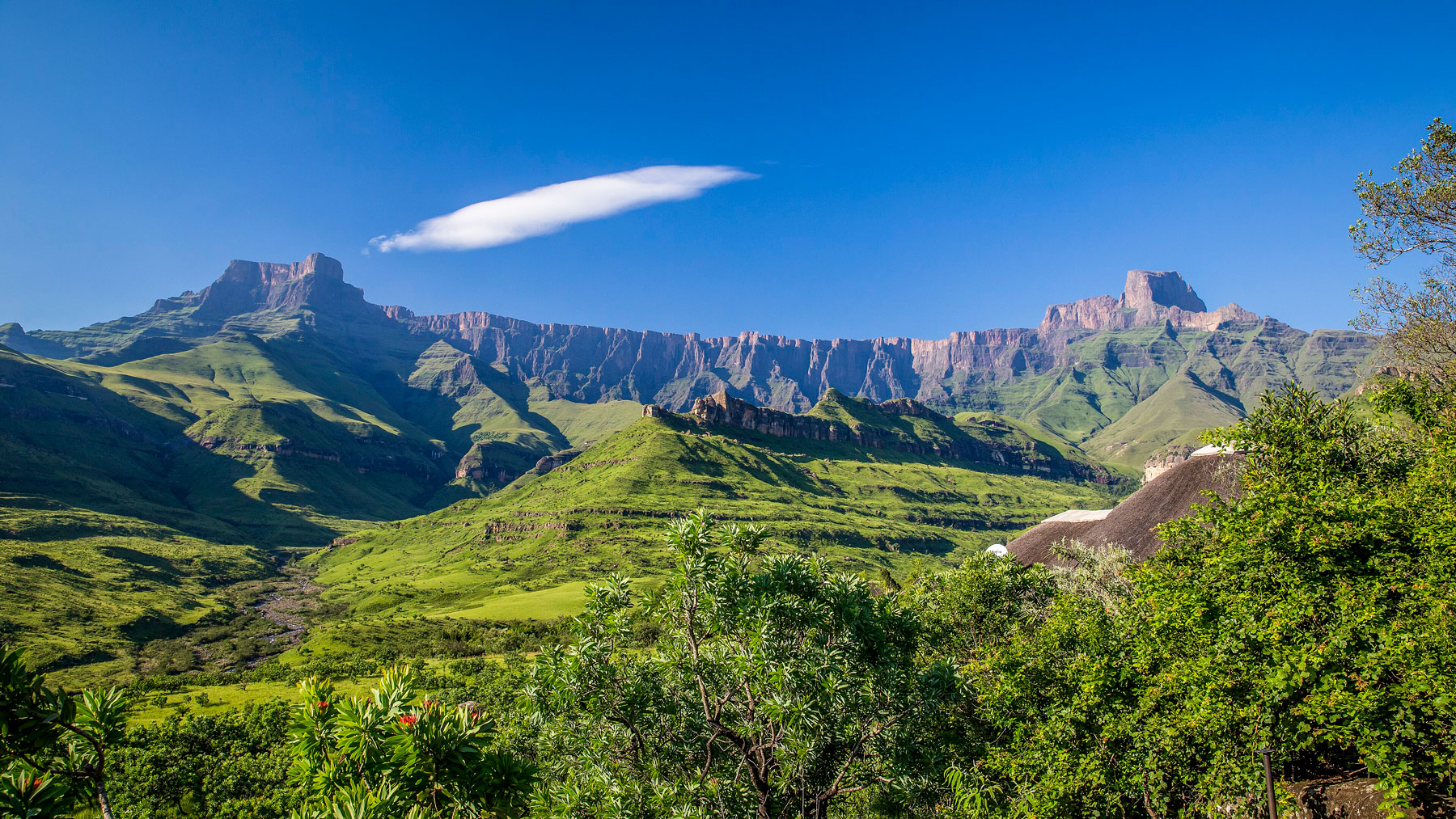 View of the Drakensberg escarpment from the Royal Natal National Park.
Photo: Diriye Amey
View of the Drakensberg escarpment from the Royal Natal National Park.
Photo: Diriye Amey
Geography of South Africa
South Africa occupies at the southern tip of the African continent. Its landscape features grasslands, scrublands, forests, deserts, mountains, and coastal wetlands.
The country has a 2,700 km long coastline, stretching along the
South Atlantic Ocean in the west and the
Indian Ocean in the east.
Much of
South Africa's territory consists of a large highland, the southern part of the
South African Plateau. The plateau is fringed in the west, south and east by the
Great Escarpment, a rugged transition zone that drops toward the narrow coastal plains.
The eastern portion of the Great Escarpment is the
Drakensberg, The highest peaks within the Drakensberg escarpent are
Thabana Ntlenyana, at 3,482 m (11,424 ft) in Lesotho and
Mafadi (3,450 m (11,319 ft)), South Africa's highest mountain.
Situated on South Africa's plateau is the
Highveld, a high-altitude grassland north of Lesotho, and the
Karoo regions, a vast semi-desert region in Western Cape province, divided into the
Great Karoo and
Little Karoo. This arid landscape covers much of the southwestern part of the country. The Karoo is rich in fossils and features unique plant life, and shapes much of the country's inland character.
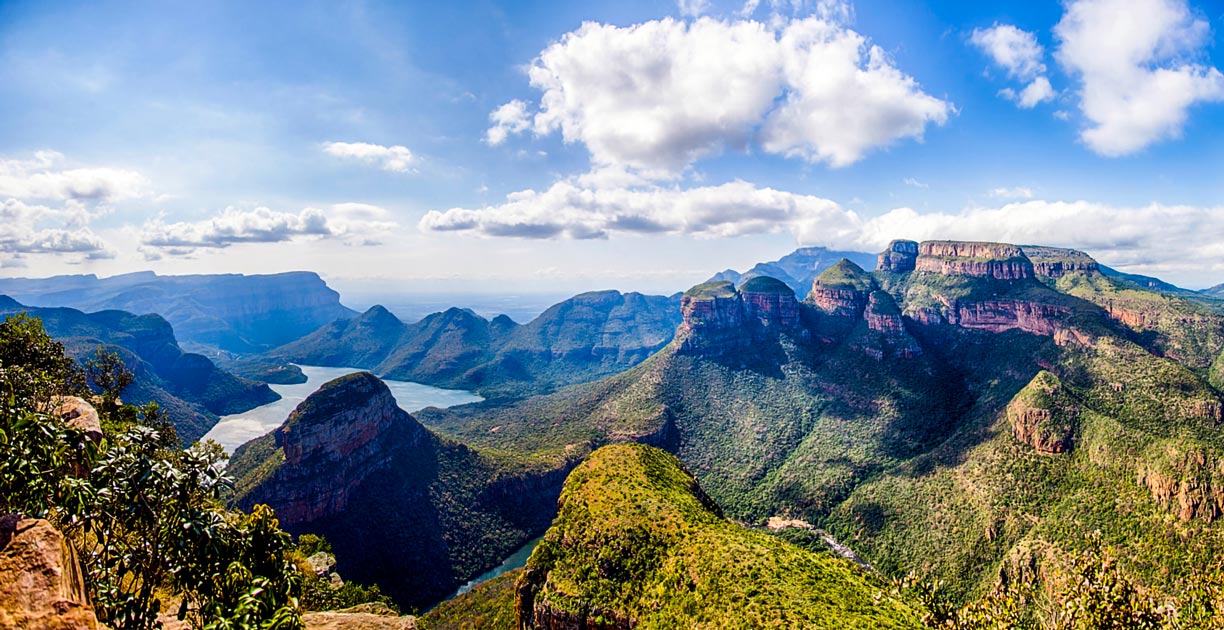 View of the Blyde River Canyon from Three Rondavels View Point. The three Rondavels and Mapjaneng table mountain to the right. The Blyde River Canyon Nature Reserve is situated in the Drakensberg escarpment region of eastern Mpumalanga, about 100 km north of Mbombela (Nelspruit).
Photo: John Detweiler
Velds are mainly the flat or plateau-like regions in the interior of the country.
- The Bushveld is a subtropical woodland ecoregion north of Pretoria and the Witwatersrand Ridge (The Rand), a gold-bearing highland region in Gauteng province.
- The Highveld is the name given to the highlands of South Africa that slope down towards the north. The vegetation consists mainly of grassland; scrubland is found only in the hills and on the river terraces.
Mountains
South Africa's highest mountains are almost all peaks of the Drakensberg ("Dragon Mountains"), the eastern section of the Great Escarpment. The highest mountains of the Great Escarpment, with altitudes ranging from 2,000 to 3,482 meters, are located in the border region of South Africa and Lesotho.
The
highest mountain in South Africa is
Mafadi at 3,450 m (11,320 ft), a peak on the South African - Lesotho border. The highest mountain in the
Drakensberg range is
Thabana Ntlenyana (3,482 m), located in Lesotho.
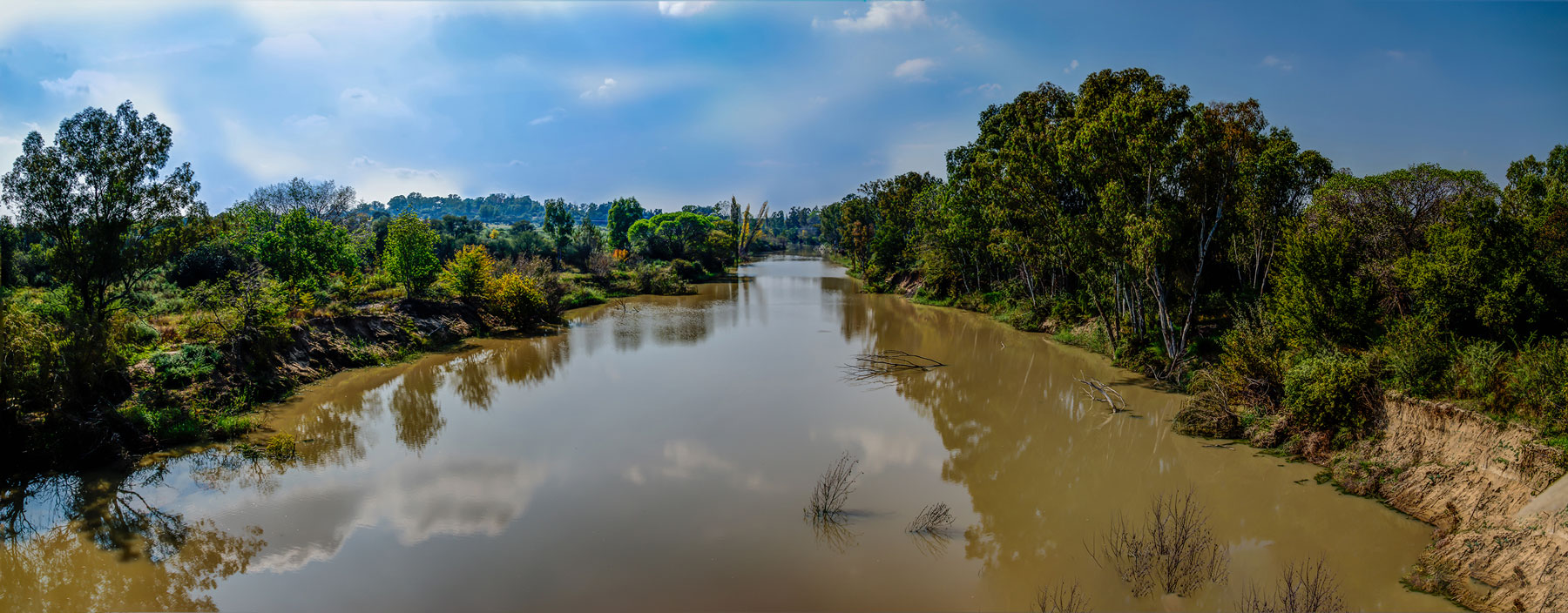 The Vaal River in the Vanderbijlpark in South Africa's Gauteng province.
Photo: © Paul Saad
The Vaal River in the Vanderbijlpark in South Africa's Gauteng province.
Photo: © Paul Saad
Rivers
Orange River
The Orange River is the longest river in South Africa, stretching 2,432 km (1,511 mi). Its name comes from the Dutch/Afrikaans Oranjerivier—Oranje (orange) being the national color of the Dutch kingdom.
The river rises in the
Drakensberg Mountains in northeastern Lesotho and flows westward through South Africa's Eastern Cape, Free State, and Northern Cape provinces. It forms the southern border between Namibia and South Africa before emptying into the Atlantic Ocean.
Vaal River
The Vaal River, the largest tributary of the Orange, is 1,120 km long. It originates north of the town of
Ermelo in
Mpumalanga province.
Limpopo River
The confluence of the
Marico River and the
Crocodile River in South Africa's
North West Province creates the
Limpopo River. South Africa's second-longest river generally flows eastward. The river forms parts of South Africa's borders with Botswana and Zimbabwe, then flows through Mozambique, where it empties into the
Indian Ocean near the city of
Xai-Xai.
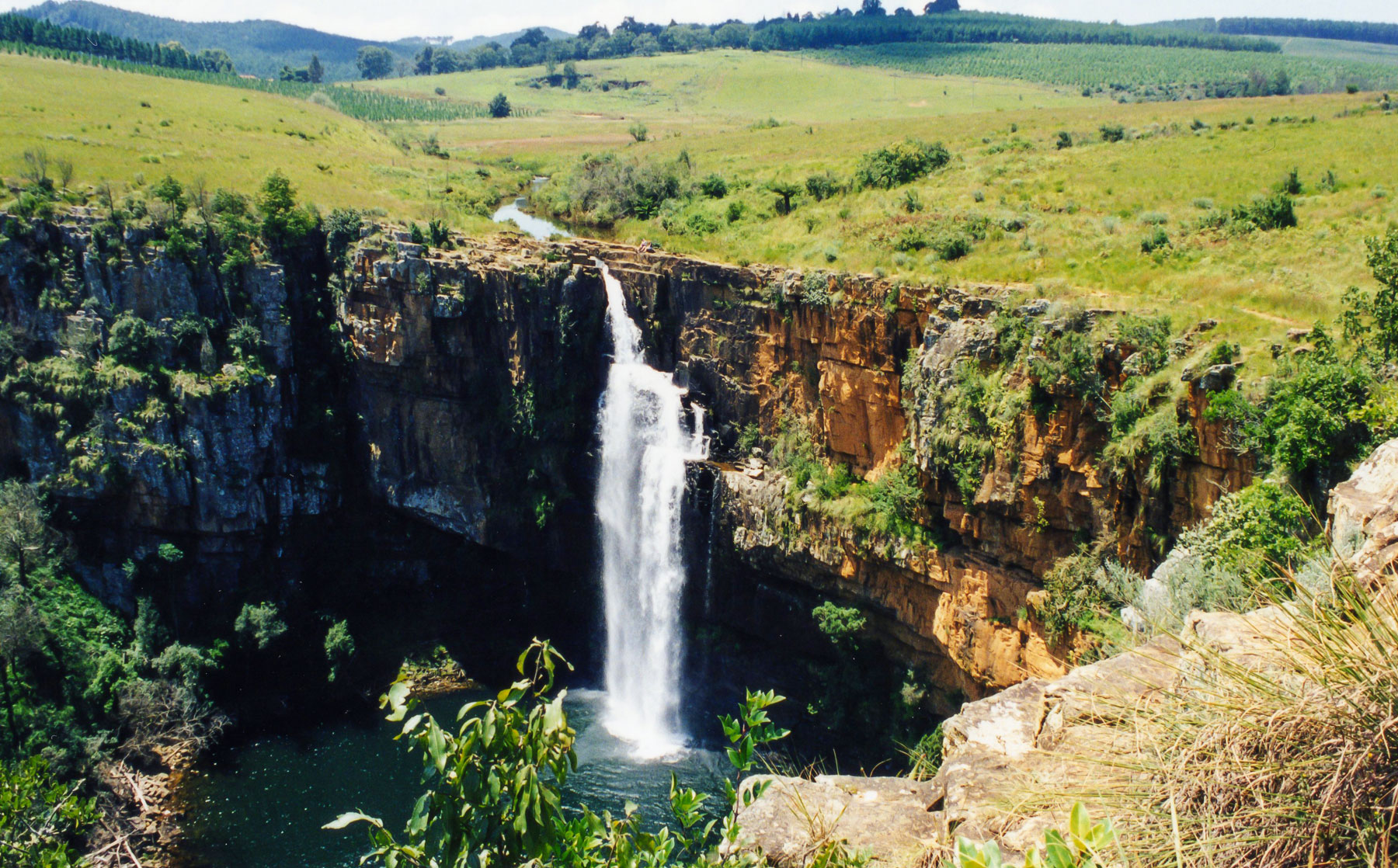 The Berlin Falls, formed by the Sabine River, is the highest waterfall in South Africa's Mpumalanga province.
Photo: Caitlin
The Berlin Falls, formed by the Sabine River, is the highest waterfall in South Africa's Mpumalanga province.
Photo: Caitlin
The Tugela River (Zulu: Thukela) is the largest river in
KwaZulu-Natal Province. It flows for about about 500 km (310 mi) from the
Drakensberg Mountains (Mont-aux-Sources) to the Indian Ocean. The river is famous for the
Tugela Falls, often cited as the world's second-tallest waterfall. The river plays a key role in regional agriculture and water supply.
Great Fish River
The Great Fish River (in Afrikaans: Groot-Visrivier) is located in the
Eastern Cape, it runs for about 645 km (400 mi) and empties into the Indian Ocean. The river is historically significant, it once marked the frontier between
colonial settlers and the
Xhosa people during the 19th-century frontier wars.
Kalahari Desert
The Kalahari Desert is a vast thornbush savanna in southern Africa that encompasses much of Botswana and parts of Namibia, as well as South Africa's border region with both countries.
Cape Agulhas
Cape Agulhas is the southernmost point of the African continent. The
20th meridian, located at Cape Agulhas, represents the (imaginary) boundary between the Atlantic Ocean and the Indian Ocean.
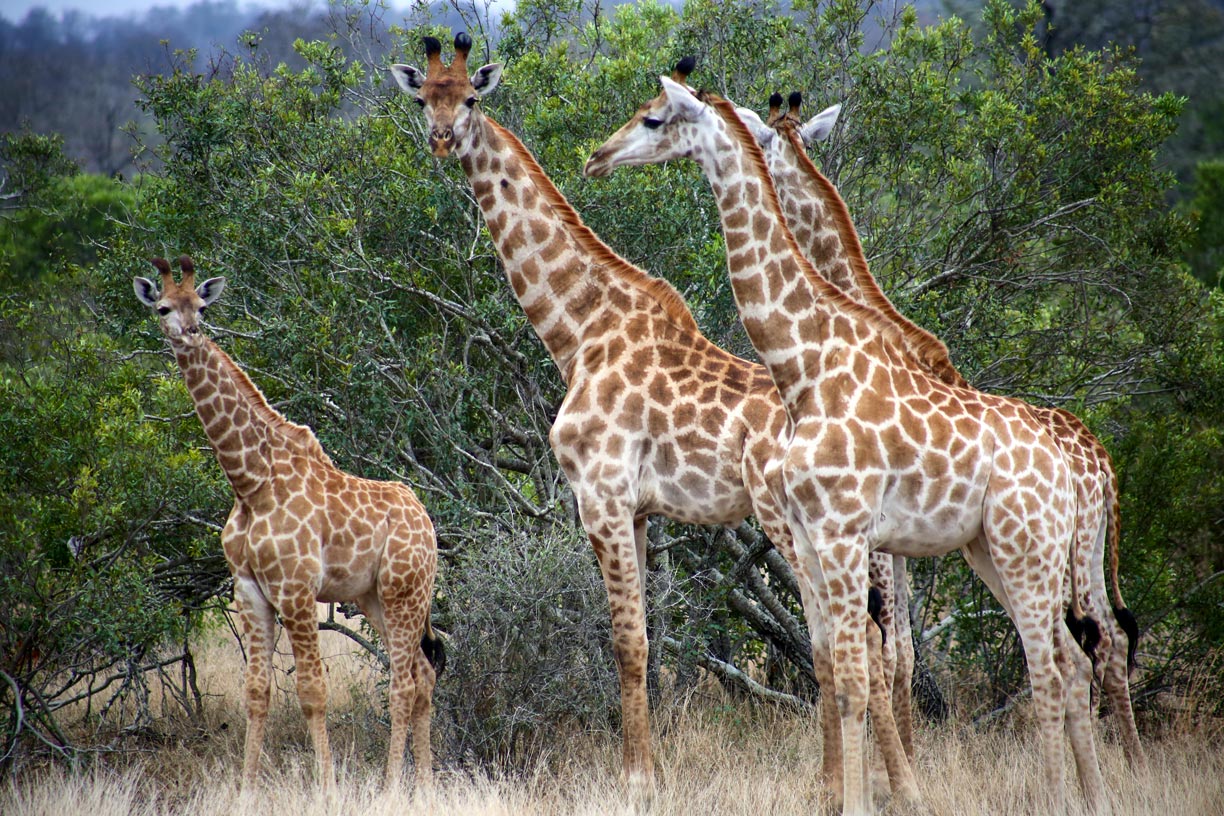 Cape giraffes in Kruger National Park. With an area of 19,623 km² the park is one of the largest game reserves in Africa.
Photo: flowcomm
National Parks
Among the more than 20 national parks in South Africa,
Kruger National Park is probably the most important and the most famous. It is one of Africa's largest game reserves and the country's first national park (est. in 1926). Since 2000, Kruger National Park has been part of a 35,000 km² transboundary protected area (TBPA), the
Great Limpopo Transfrontier Park, which links Kruger National Park with
Gonarezhou National Park in Zimbabwe and
Limpopo National Park in Mozambique.
The
Kgalagadi Transfrontier Park is a large game reserve in the Kalahari Desert shared by Botswana and South Africa. The park is home to big cats and hyenas as well as migratory herds of large herbivores such as gnus, springbok and other antelopes and gazelles.
The
Addo Elephant National Park is the third largest wildlife reserve in South Africa and is located near Port Elizabeth; it was established in 1931 to provide a refuge for the eleven remaining elephants in the region. Today it is home to more than 600 elephants and a large number of other mammals.
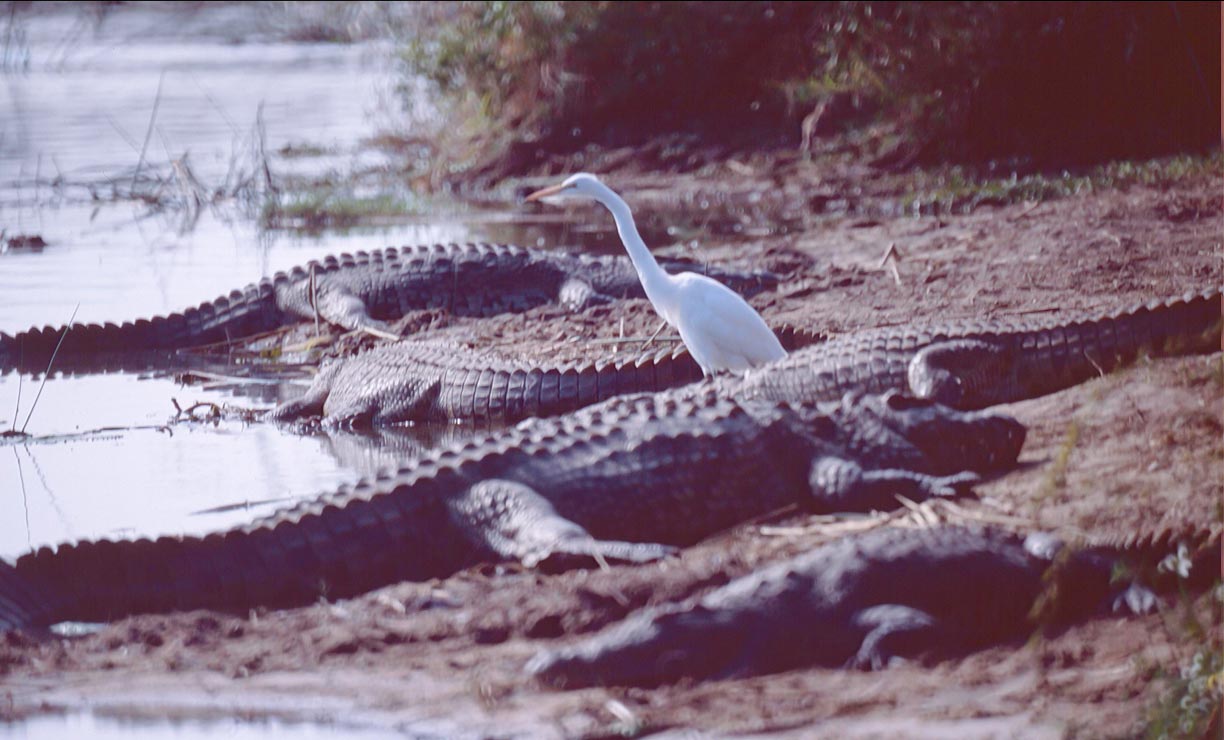 Kruger National Park, South Africa, a Yellow-billed Egret among a group of Nile crocodiles. The game reserve was established in 1898 by President Kruger and became a national park in 1926.
Photo: Patrik M. Loeff
Kruger National Park, South Africa, a Yellow-billed Egret among a group of Nile crocodiles. The game reserve was established in 1898 by President Kruger and became a national park in 1926.
Photo: Patrik M. Loeff
Biodiversity
South Africa is rich in biodiversity. It is one of the world's 17 megadiverse countries. It holds a significant portion of the world's biodiversity. South Africa is home to nearly 300 species of mammals, around 860 bird species, and some 8,000 types of plants.
Climate
The climate of South Africa ranges from a subtropical climate in the southwestern corner, the winter rainfall region of South Africa around Cape Town. There is an arid desert climate in the northwest (Kalahari), a semi-desert climate in the Great Karoo region, while the interior Central Plateau (Highveld) has a temperate climate. Southern Africa has warmed twice as fast as the rest of the world over the past five decades, with serious consequences for the population, agriculture and the environment.
Issues South Africa
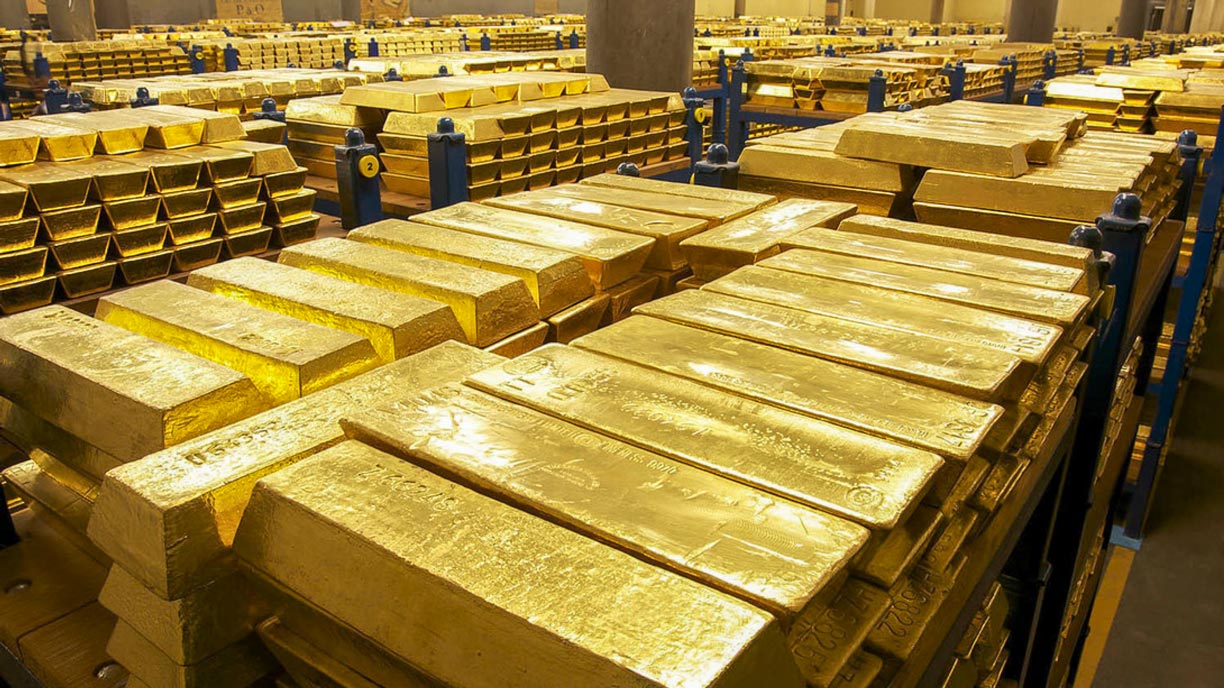 The fruits of hard labor - Pure Gold from the Mponeng Gold Mine in Carletonville in South Africa's Gauteng province. The mine lies in the center of the richest gold-mining area in the world. Gold at the Mponeng mine is mined at a depth of 3.16 km to 3.84 km. At this depth, the rock reaches a temperature of 66 °C (151 °F). To cool the tunnel air to below 30 °C (86 °F), ice slurry is pumped underground.
Photo: MPO Mine
South Africa is rich in natural resources, and a leading producer of agricultural products.
Major exports are raw materials and refined products.
The country's key
mineral resources include gold, diamonds, platinum, vanadium, and ferrochrome. Other important minerals are chrome, manganese, vermiculite, coal, iron ore, nickel, phosphates, tin, and
rare earth elements.
In addition to its mineral wealth, South Africa also exports cars, corn, fruit, wine, sugar, and wool, making it a significant player not only in mining but also in agriculture and manufacturing.
South Africa's Environmental Issues
South Africa faces a range of environmental challenges. Key issues include
air and water pollution, primarily caused by mining,
coal-fired power plants, and
heavy industries such as smelters, cement works, and chemical production.
Rivers are further polluted by
agricultural runoff and
urban wastewater discharge. Water scarcity is a growing concern. The country has
few large rivers and
no major natural lakes, and
water demand is
rising faster than supply, driven by urbanization, industry, and agriculture.
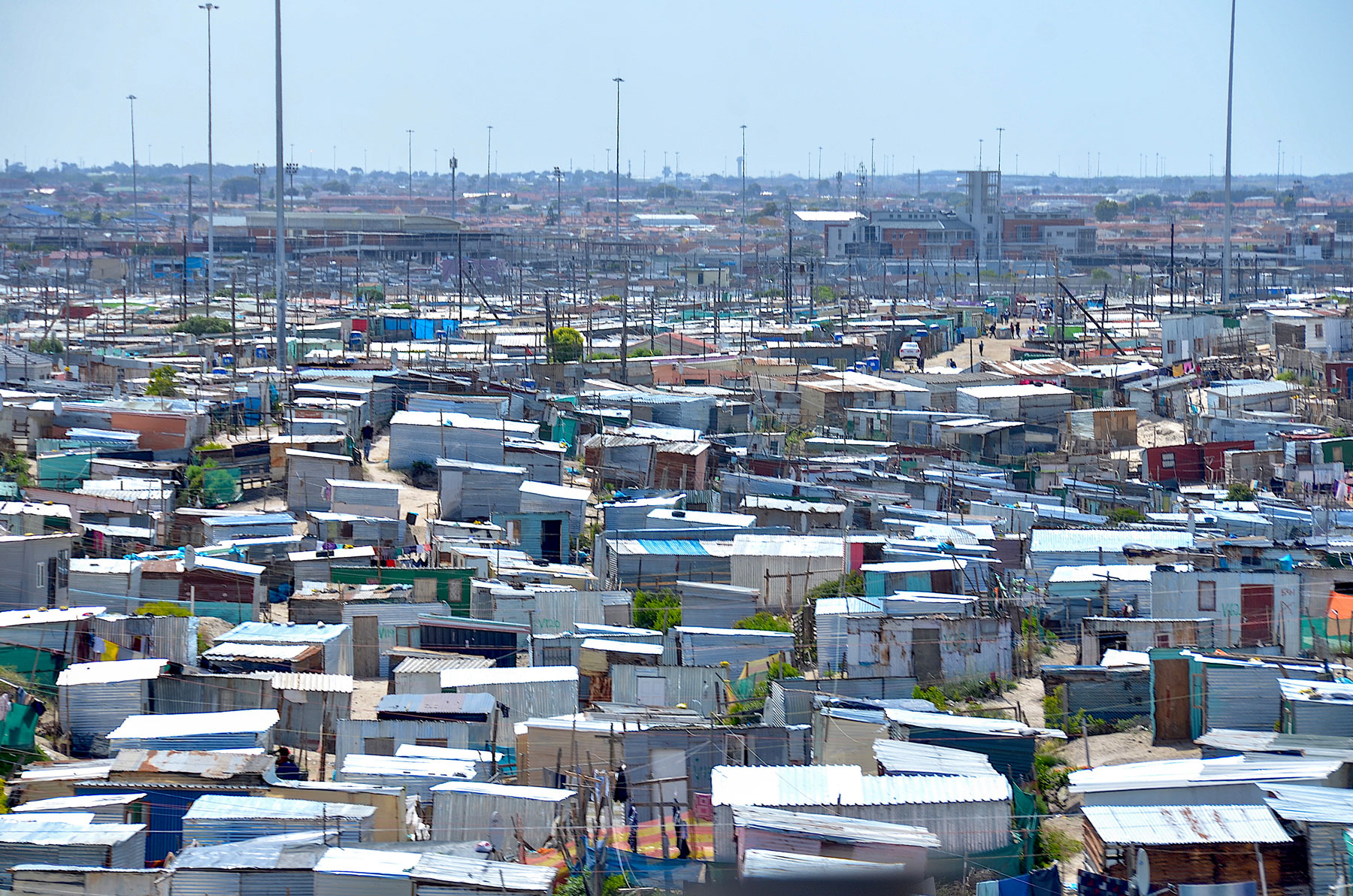 Khayelitsha township in south eastern part of Cape Town along Baden Powell Drive.
Photo: Olga Ernst
Power shortages are frequent. More than 80% of South Africa's electricity comes from coal, and aging infrastructure often leads to power plant failures and widespread outages as demand outpaces supply.
[GFW] The disruption of fragile ecosystems has resulted in significant plant extinctions.
Deforestation, the total area of humid primary forest in South Africa decreased by 9.0% in the last decade.
[GFW] The disruption of fragile ecosystems has resulted in significant plant extinctions.
South Africa's Natural Hazards
Major natural disasters are rare in South Africa. The country is not prone to earthquakes, hurricanes, or volcanic activity. However, it does face human-made hazards that can lead to serious consequences. These include mining accidents, industrial and environmental disasters (such as oil or chemical spills), and, on rare occasions, terrorist incidents. While less dramatic than natural disasters, these events can have severe impacts on communities, ecosystems, and infrastructure.
Crime and Rural Violence in South Africa South
South Africa faces some of the highest crime rates globally, driven by
widespread poverty,
unemployment, and
deep social inequality. Violence affects both urban townships and rural areas, where limited policing leaves communities vulnerable. Among the victims are also commercial farmers, including many Afrikaners, who have been targeted in violent attacks. While these incidents are tragic and politically charged, there is no evidence of an organized campaign or genocide. These incidents are part of the overall challenges facing the country, which is struggling with violent crime, economic inequality and a legacy of land conflicts in a complex post-apartheid reality.
[SAG]
The map shows the location of the following South African cities and towns:
Aberdeen, Aliwal North, Amanzimtoti, Beaufort West, Bethlehem, Bhisho, Bloemfontein (judicial capital of South Africa, Sesotho name is Mangaung), Calvinia, Cape Town (third most populous city and the legislative capital), De Aar, Durban (major seaport and the third largest city), East London, Ermelo, Estcourt, George, Graaff- Reinet, Hotazel, Johannesburg (largest city and industrial and mining capital), Kathu, Kimberley, Klerksdorp, Knysna, Kroonstad, Ladysmith, Mafikeng, Makhanda, Middelburg, Mossel Bay, Mthatha, Musina (Messina), Nelspruit (Mbombela), Newcastle, Oorkruis, Orkney, Oudtshoorn, Paarl, Pietermaritzburg, Polokwane (formerly Pietersburg; capital of Limpopo province), Port Alfred, Port Elizabeth (major seaport), Port Nolloth, Port Shepstone, Postmasburg, Pretoria (administrative capital of South Africa), Prieska, Queenstown, Richards Bay, Rustenburg (a major city in North West Province), Springbok, Stellenbosch, Strand, Swellendam, Uitenhage, Upington, Vereeniging, Victoria West, Vioolsdrif, Vredenburg, Vredendal, Vryheid, Welkom, and Worcester.
Advertisements:




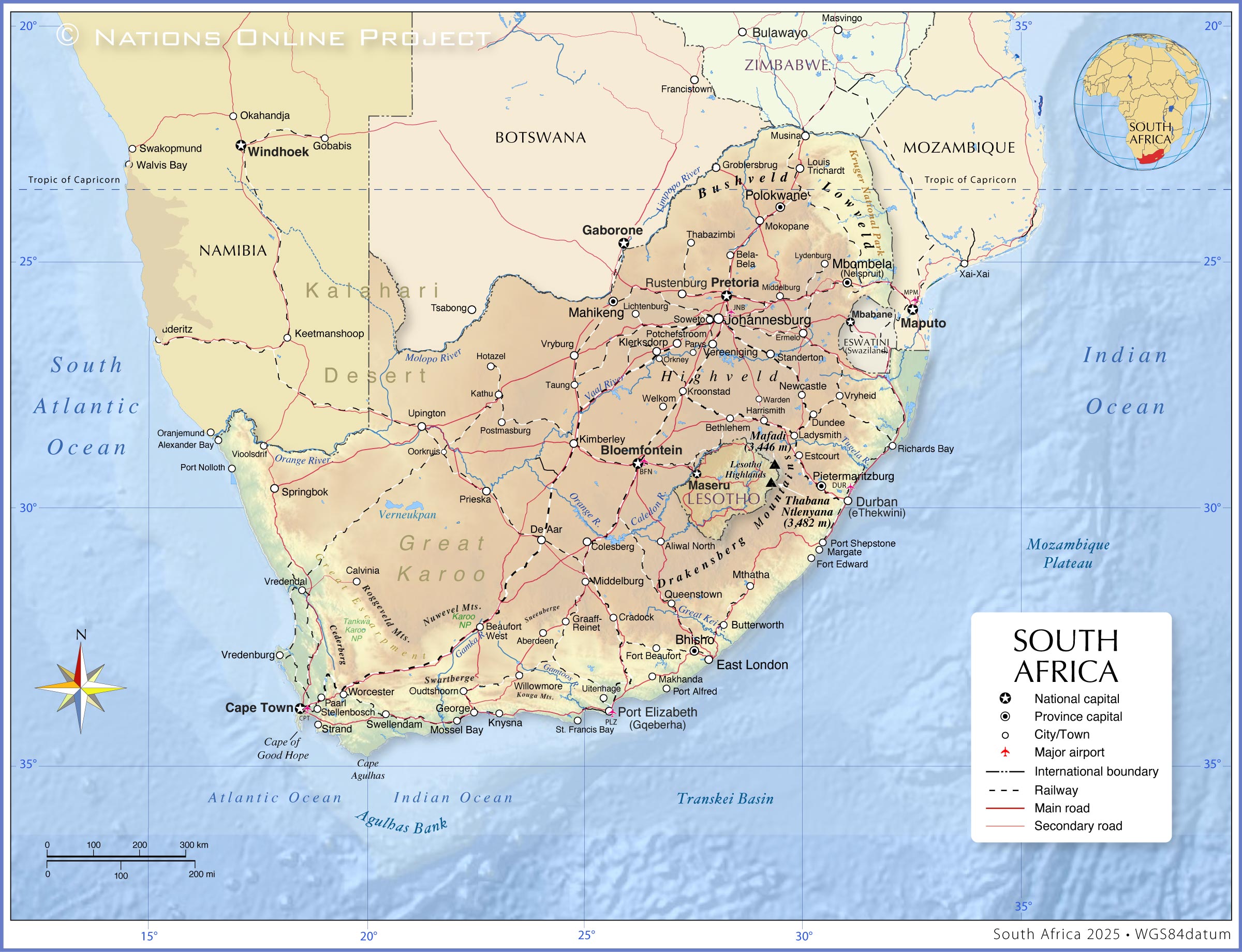
 You are free to use the above map for educational and similar purposes; if you publish it online or in print, you need to credit the Nations Online Project as the source.